
Coinciding with Innovation Month
“Khalifa Award”: Innovation is the pillar of educational excellence
Amal Al-Afifi: Innovation Month highlights innovative projects and initiatives that serve national development
Wafa Zaghbar: The necessity of placing the student at the center of the educational process by adopting an educational approach based on interaction
Abu Dhabi: Thursday, February 22, 2024
The General Secretariat of the Khalifa Award for Education stressed the importance of innovation and its role in distinguishing the education system at its various educational levels, especially in the early childhood stage, as innovation represents the cornerstone of discovering, nurturing, and directing student talents towards achieving the desired goals in advancing the national development process in various fields.
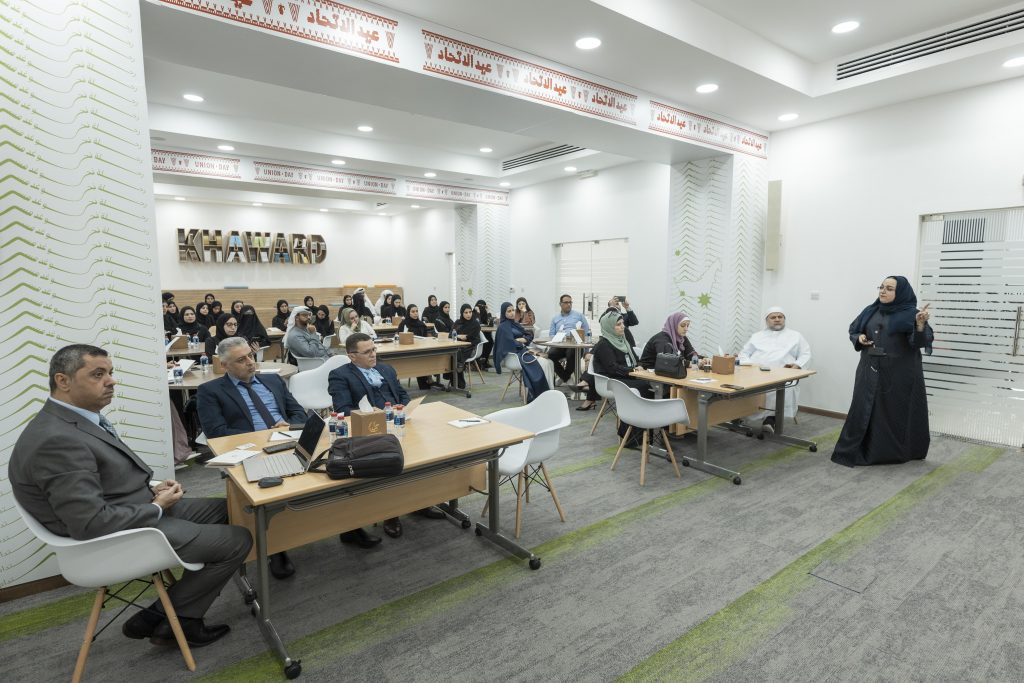
This came during the applied workshop organized by the General Secretariat of the Khalifa Award for Education at its headquarters in Abu Dhabi, entitled “Towards future Innovative Education,” in which Dr. Wafa Zaghbar, Associate Professor at the Center for Educational Innovation at Zayed University, spoke in the presence of Amal Al-Afifi, Secretary-General of the Khalifa Award for Education, and a number of faculty members. And administration in various educational institutions in the country.
Amal Al-Afifi stressed the importance of this applied workshop, which comes in the context of the award’s induction program in its current session and its message in spreading the culture of excellence in the educational field, noting that the workshop coincides with the month of innovation, which the government of the United Arab Emirates has made one of the prominent events. Throughout the year, through which federal and local ministries and government agencies highlight innovative projects and initiatives that serve the national development process.
For her part, Dr. Wafa Zaghbar stated, “We live in an era characterized by rapid technological development and rapid social transformations, and this requires us to reconsider how we approach education and design educational programs to keep pace with these challenges and take advantage of the new opportunities that arise.”
She added that since education is a fundamental pillar for developing societies and achieving progress and prosperity, continuous development it is imperative. Therefore, we must focus on innovative education that encourages critical thinking, enhances life skills and innovation, and facilitates lifelong learning. Education should be flexible and diverse, using technology effectively to provide rich and stimulating learning experiences.
Dr. Zaghbar additionally confirmed, “We should also place the student at the center of the educational process by adopting an educational approach based on participation and interaction, taking into account the accelerating pace of technological and life changes in society, and the centrality of the educational process. This path requires empowering the teacher to develop in a flexible and rapid manner. To keep pace with these changes, which can reflect positively on the student and enable them to build knowledge and develop skills through practical experiences and problem solving.
Dr. Zaghbar added during the applied workshop: “Change and growth cannot be if institutions work separately, but rather we need a strong partnership between schools, universities, educational institutions, society and the media as one body working in integrated coordination with the aim of achieving a unified message, and to achieve effective and sustainable change in the education system, to ensure Preparing generations more prepared to face the challenges of the future and contribute to building more prosperous and developed societies.