
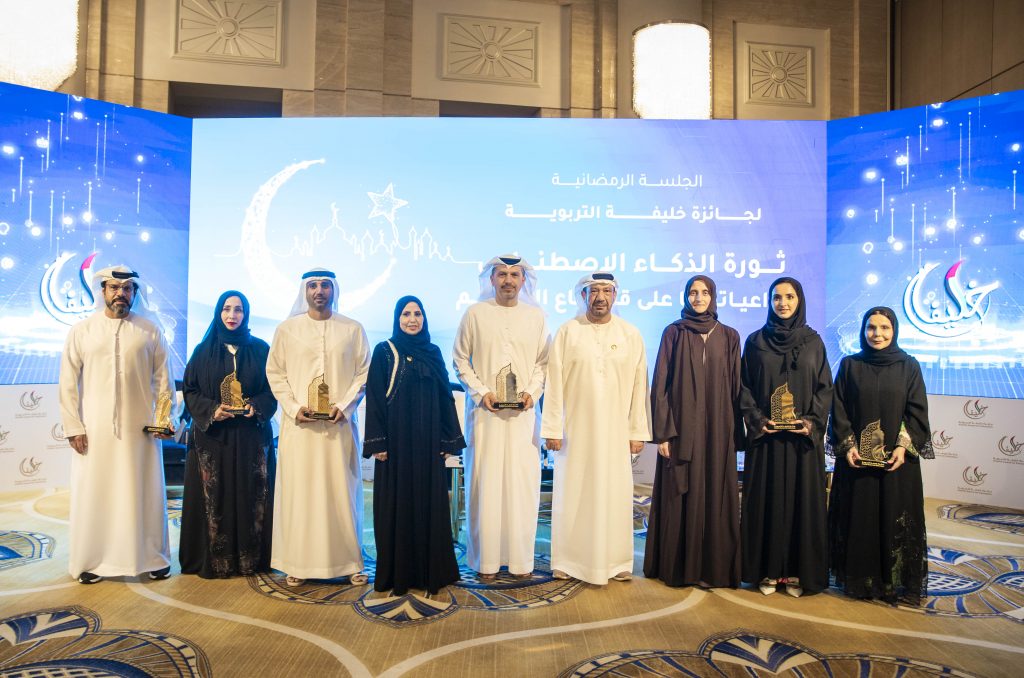
During a one of the Ramadan sessions in Abu Dhabi
“Khalifa Award”: developing curricula and cognitive content for interaction with artificial intelligence is a necessity
Amal Al-Afifi: Instilling advanced technological skills in young people and students
Arif Al Hammadi: Supporting technological innovations and employing responsible artificial intelligence tools is what we thrive to achive
Mohammed Al-Loughani: The UAE is considered one of the pioneers in adopting technology and innovation
Ibtisam Al Mazroui: Artificial intelligence represents a major focus in achieving personalized education
Maryam Al Yamahi: Artificial intelligence is one of the most important trends in the next twenty years
Khadija Al-Hamid: Fundamental transformations in labor market functions during the next 5 years
Khaled Al Abri: Artificial intelligence has become an essential feature of daily life
Abu Dhabi: Wednesday, March 20, 2024
The General Secretariat of the Khalifa Award foe Education stressed the importance of continuing to develop the educational process in all its elements to keep pace with the scientific development witnessed by the world in advanced technology, and employing artificial intelligence in the educational process. This step requires developing the curriculum and the academic and cognitive content provided to the student so that it qualifies students and young people at an early age to interact with developments in advanced technology and artificial intelligence and the comprehensive changes associated with it in the learning environment, which became mainly dependent on artificial intelligence tools.
This came during the annual Ramadan session organized by the award in Abu Dhabi entitled “The Artificial Intelligence Revolution and its Repercussions on the Education Sector,” and was attended by Mohammed Salem Al Dhaheri, member of the Board of Trustees of the Khalifa Award for Education, Amal Al Afifi, Secretary-General of the Khalifa Award, Dr. Souad Al Suwaidi, Deputy Secretary-General of the Award, members of the Award’s Executive Committee, and a number Among the academic and educational leaders and parents. Among the distinguished guest speakers are: Dr. Arif Al Hammadi, Executive Vice President of Khalifa University, Dr. Mohammed Al-Loughani, Advisor to the President of Mohammed bin Zayed University for Artificial Intelligence, Dr. Ibtisam Al-Mazrouei, an expert in artificial intelligence and advanced technology and founder of AIE3, and Dr. Maryam Al-Yamahi, Assistant Professor at the College of Infomation Technology at the UAE University, and Dr. Khadija Al-Hamid, Professor and Director of Student Affairs Department at Rabdan Academy, and it was moderated by Dr. Khaled Al-Abri, member of the Award’s Executive Committee.
At the beginning of the session, Amal Al-Afifi stressed the keenness of the Khalifa Award, through its mission and the fields presented, to spread the culture of excellence in the educational field, both university and pre-university, and from here comes the importance of this Ramadan session, which highlights the close relationship between education and artificial intelligence, and contributes to enhancing the exchange of expertise and experiments in accordance with the best scientific and applied practices that aim to highlight the role of artificial intelligence in improving the learning environment, and the importance of instilling advanced technological skills in the hearts of young people and students and training them to apply them in the classroom environment and in the education process in general.
Dr. Khaled Al-Abri pointed out that the Khalifa Award sheds light, through this group of experts and specialists, on an important axis in our daily lives, namely artificial intelligence, which has become an essential feature of daily life in various parts of the world.
For his part, Dr. Arif Al-Hammadi presented an intervention during the session in which he reviewed the scientific and historical development of the concept of artificial intelligence since the middle of the last century and the efforts of scientists to innovate and develop artificial intelligence tools in various sectors, especially in the industrial and technological sectors and the telecommunications sector, all the way to the field of education, which today is witnessing a technical revolution. In applications of artificial intelligence, he pointed out that Khalifa University was a pioneer in this field by employing artificial intelligence in the educational process and the associated development of the learning environment, laboratories, skills possessed by the faculty member, and other aspects of artificial intelligence in the classroom, educational and research environment.
Dr. Al Hammadi referred to the recent controversy regarding the ethical standards of artificial intelligence and its unlimited applications, and the necessity of linking the use of artificial intelligence to standards of responsibility, especially in light of the innovative applications that have become a fundamental pillar in the educational process, stressing that the scientific sector takes from artificial intelligence the proper extent within a framework of responsible controls and values that enable the student and teacher to carry out their educational roles in a transparent and objective manner.
Al-Hammadi pointed out that some see artificial intelligence as having negative effects on the educational process and are calling for preventing the use of its tools in the learning environment. Here we say that creativity and innovation in technology should not be limited, but rather we must create a supportive environment and encourage the expansion of applications of responsible artificial intelligence, and this is what is done in the United Arab Emirates, which has made great strides in terms of artificial intelligence in various areas of life.
For his part, Dr. Muhammad Al-Loughani stressed that the United Arab Emirates is considered one of the pioneers in adopting technology and innovation, which includes smart technology and artificial intelligence. With the rapid development of these technologies, We must understand how it will affect the future of education and what the opportunities and challenges are. This axis also focuses on how artificial intelligence will affect the future of education by reviewing the challenges that may face the educational system, and the extent to which it adapts to these rapid technological developments. With regard to the labor market, the focus is on the impact of artificial intelligence on the nature of jobs and skills required, and how new opportunities can arise as a result of the use of smart technology.
He pointed out the importance of camaraderie between the government and private sectors to absorb the challenges and benefit from the opportunities available in this advanced era of technology, to achieve comprehensive and sustainable development in the field of education and the labor market in the UAE.
Dr. Ibtisam Al Mazrouei said: In an era in which the features of education are being reshaped thanks to technological progress, artificial intelligence and the metaverse emerge as active elements in shaping the future of education. Artificial intelligence is considered a major pivot in achieving personalized education, as it can provide an educational experience specifically designed for each student, taking into account their abilities and Individual needs.
Artificial Intelligence also contributes to in-depth analysis of student data, enabling accurate educational recommendations that enhance students’ understanding and motivate them to learn. Its role is not limited only to students, but is a valuable tool for teachers as well, as it enables them to develop curricula and evaluate student performance more efficiently.
Al Mazroui added: The metaverse is an immersive educational environment that allows students to interact with educational content in innovative ways, which enhances experiential and collaborative learning. Artificial intelligence facilitates access to educational resources, which reduces the educational gap and enhances self-learning opportunities. Investing in artificial intelligence and the metaverse is also an investment in the future of education, it could radically transform how we learn and teach, promising a bright future for global education. Certainly, advanced technology such as artificial intelligence and the metaverse should be used to enhance, not replace, basic educational foundations, and must remain the core elements of education – such as developing critical thought, scientific reasoning, and literary appreciation – at the heart of the educational process.
Dr. Maryam Al Yamahi pointed out that the world is witnessing an upcoming wave, which is artificial intelligence, and we want to be the country most prepared for it. The statement of His Highness Sheikh Mohammed bin Rashid Al Maktoum, Vice President and Prime Minister of the UAE and Ruler of Dubai, may God protect him, comes as an embodiment of the future of a country that has always been a pioneer in The region is shaping its future and dealing with global future tools.
Dr. Al Yamahi added: Artificial intelligence is one of the most popular trends in global societies in the next twenty years, and despite this progress in this field, it is still at the beginning of the beginning, and what is coming in development in this field will constitute a revolution like that of the industrial revolution of man not so long ago, and the future direction. The UAE’s progress in artificial intelligence and its preparation in this field demonstrates its ability to keep pace with modern technological progress, which will reflect a new revolution and a historical turning point in Emirati society, and the UAE’s strategy for artificial intelligence targets its various sectors, and the most important of these sectors is education.
The application of artificial intelligence today in the education sector has achieved great successes worldwide, and is still developing rapidly and significantly, as new applications and tools are developed every day, from personal learning supported by artificial intelligence to assessment and grading based on artificial intelligence algorithms.
She explained: The potential benefits that artificial intelligence will bring from its integration into the education sector are enormous, and its potential to change the way we learn and teach is limitless. As technology continues to develop, the use of artificial intelligence in education is expected to become more widespread and advanced, providing new opportunities in the field of education and thus creating a more personalized, effective and attractive educational experience for all students.
Dr. Al Yamahi:stated “ What the UAE and its wise government are seeking in the race for the new revolution in the presence of artificial intelligence makes it a source of pride and pride, and is also an affirmation of the ability of the UAE government and people to match progress, success and production of knowledge.”
For her part, Dr. Khadija Al-Hamid said: The current reality shows that artificial intelligence will have a tremendous impact on the labor market in the future, as it will result in radical changes in the nature of jobs and industries. The World Economic Forum’s forecasts in 2023 indicate that nearly a quarter of current jobs, or about 23% of them, will witness fundamental transformations during the next 5 years, according to employers’ estimates.
At the conclusion of the session, a dialogue took place between the speakers and the audience about the role of the school, the family, and society in general in consolidating dealing with artificial intelligence tools.
The Awarding:
Mohammed Salem Al Dhaheri, Amal Al-Afifi and Souad Al Suwaidi awarded the participants in the Ramadan session.
The Awards
The session witnessed the distribution of prizes to the audience in appreciation of their participation and interaction with the award activities.