
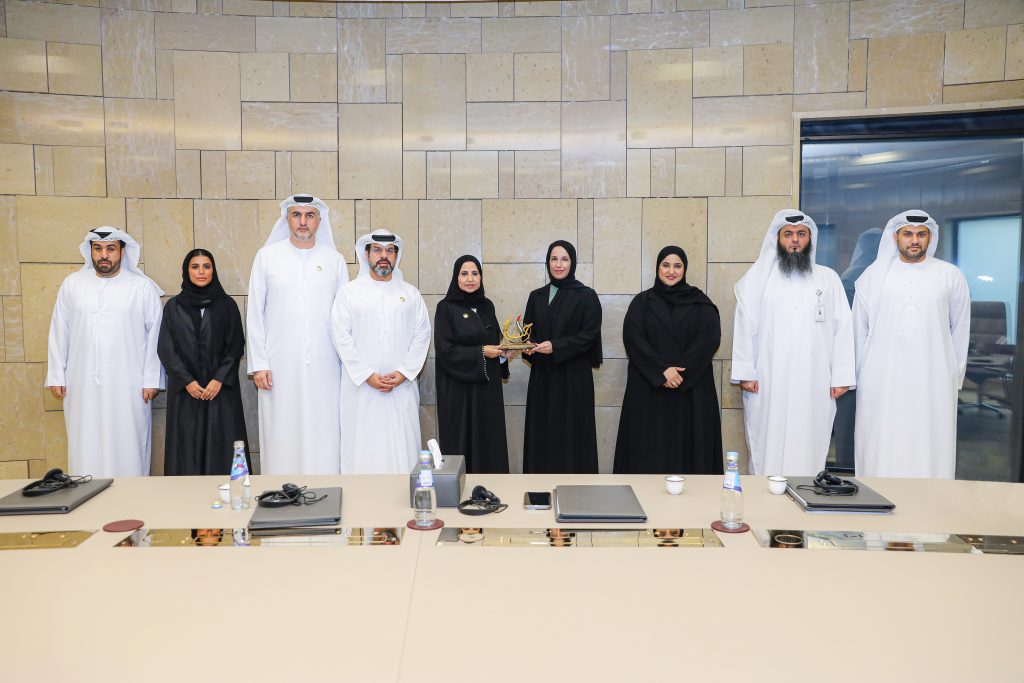
During the reception of the “Khalifa Award for Education” delegation in Doha
Qatar’s Minister of Education: Our relations are fraternal, and the education system is pioneering in shaping the future
Amal Al-Afeefi:
The Award takes pride in the distinguished didactic contributions from the field in Qatar.
Thursday, November 7, 2024
Her Excellency Dr. Buthaina bint Ali Al-Jaber Al-Nuaimi, Minister of Education and Higher Education in Qatar, emphasized the excellence of the fraternal relations between the two brotherly countries—both at the leadership, governmental, and societal levels. Her excellency pointed out that these relations have deep roots between two peoples united by a common destiny, a shared goal, and a promising future, driven by the determination and sincerity of the leaderships of both countries and their ongoing efforts to achieve the best interests of their peoples, ensuring dignity, growth, and prosperity in all aspects of life.
She highlighted the importance of the developments taking place in the education sector in both countries, which reflect the visionary leadership in both countries regarding the role of education and its objectives. This role is key in building individuals who are proud of their national identity, honored by their cultural heritage, and always eager to engage with the rapid progress in various scientific fields.
This statement came during her reception of the delegation from the General Secretariat of the Khalifa Award for Education, which is currently visiting the State of Qatar. The delegation includes: Amal Al-Afeefi, the Secretary-General of the Award; Dr. Khalid Al-Abri, a member of the Executive Committee of the Award; and Hamid Ibrahim, a member of the Executive Committee of the Award. The meeting was also attended by Maha Zayed Al-Ruwaili, Assistant Undersecretary for Education Affairs at the Ministry of Education and Higher Education, Nasser Saleh Al-Marri, Coordinator of the Khalifa Award for Education and Head of the Islamic Education Department at the Ministry’s Educational Guidance Division, Khalifa Al-Kubaisi, Director of the Minister’s Office, Sahar Al-Amadi from the Minister’s Office, and Rashid Abdulrahman Al-Ali, Deputy Ambassador of the UAE to the State of Qatar.
At the beginning of the meeting, Her Excellency Dr. Buthaina bint Ali Al-Jaber Al-Nuaimi expressed her appreciation for this visit by the Khalifa Award for Education, affirming the Award’s significant role in promoting excellence in the educational field, and its efforts to explore ways for the development of education by motivating those working in this vital sector to launch initiatives, programs, and innovative projects that enhance the quality of instructive performance at all stages, which in turn positively impacts student excellence as the core of the educational process.
For her part, Amal Al-Afeefi expressed her gratitude for the warm reception and conveyed the delegation’s eagerness to enhance the frameworks of joint cooperation with the Ministry of Education and Higher Education in various departments and entities under the Ministry, as well as with the educational field. She affirmed that the award takes pride in the distinguished contributions and participations from various elements of the educational field in the State of Qatar.
During the meeting, Al-Afeefi also discussed the mission and objectives of the Award, along with the categories for the 18th session, which include 10 fields distributed across 17 categories that cover various aspects of the educational process.
Dr. Khalid Al-Abri emphasized the importance of the Khalifa International Award for Early Learning field, which includes two categories: Best Research and Studies, and Best Programs, Curriculum, Teaching Methodologies, and Practices.
Al-Abri elaborated on the significance of the early learning, noting that field as this sector receives significant attention from the UAE and other developed countries that make substantial efforts to highlight outstanding practices in early childhood, providing a stimulating environment for social and educational care that opens avenues for creativity and innovation at various stages of life.
During the meeting, he also gave a brief overview of the Award’s efforts in spreading a culture of excellence in the educational field through the various sessions and fields offered, emphasizing that the primary goal of the award is to promote excellence in the educational field, discover and nurture talents, and highlight innovative initiatives, programs, and research projects that uplift educational work across all stages.
Hamid Ibrahim noted that the Khalifa Award for Education has achieved remarkable milestones in its prestigious standing as a specialized award in educational and teaching excellence egionally and globally. He explained that the award relies on absolute transparency as one of the fundamental principles in dealing with candidates’ files during the stages of screening, evaluation, and arbitration, all the way to the final stage of excellence and approval for the award. This process is built on transparency, objectivity, the uniqueness of the submitted work, and the completeness of the elements qualifying it to serve as a model in the field. He also provided a quick overview of the award’s efforts in developing its digital platforms, noting that the award’s website allows candidates to interact with the award round the clock. A specialized team is available to respond to candidate inquiries and provide technical support, allowing them to upload their applications electronically with precision and speed. This process continues during the stages of screening, evaluation, and arbitration.