
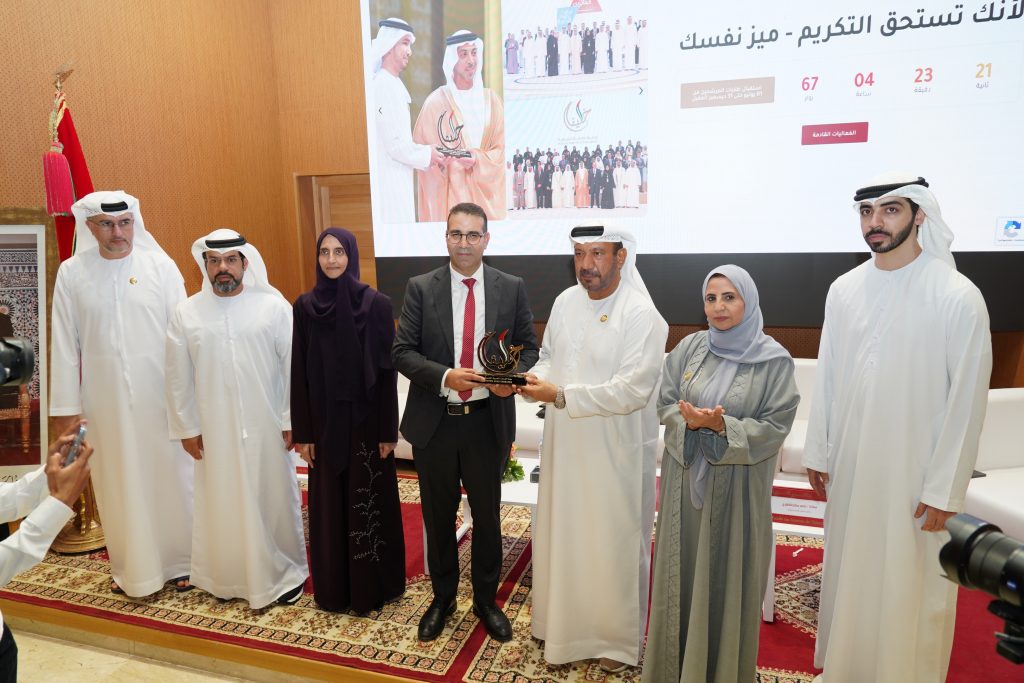
In an open meeting with teachers from the Ministry of Education and professors at Mohammed VI University in Rabat
“Khalifa Award for Education”: In the digital age, Excellence is the secret to the success of education
Mohammed Salem Al Dhaheri: The Award has recorded remarkable achievements in Education locally, regionally, and internationally
Amal Al-Afeefi: We are proud of the distinguished educational participations of our brothers in the Kingdom of Morocco
Abu Dhabi: Saturday, October 26, 2024
The delegation of the General Secretariat of the Khalifa Award for Education stressed that the excellence of the education system in the digital age is based on the excellence of all elements of the educational process, from students, teachers, school leaders, distinguished families, community institutions and strategic partners who provide support and assistance to this system, enabling it to face the challenges witnessed by the education sector in the third millennium era. The delegation offered and analytical look at the developments it is witnessing related to the industrial revolution, artificial intelligence, the Internet of Things and other technological innovations that have affected the learning environment in the current era.
This came during the open meeting organized by the General Secretariat delegation consisting of Mohammed Salem Al Dhaheri, member of the Board of Trustees of the Khalifa Award for Education, Amal Al-Afeefi, Secretary-General of the Award, Dr. Suad Al Suwaidi, Deputy Secretary-General of the Award, Dr. Khaled Al Abri, member of the Executive Committee of the Award, and Hamid Ibrahim, member of the Executive Committee of the Award, for professors of Mohammed VI University in Rabat and teachers at the Regional Academy of Education and Training for the Rabat-Sela-Kenitra region to introduce the message and objectives of the award, the fields offered, and the nomination mechanisms for the eighteenth session 2024-2025.
Mohammed Salem Al Dhaheri inaugurated the meeting by expressing his recognitions and appreciation to the family of Mohammed VI University in Rabat as well as the Regional Academy of Education and Training for the Rabat region for inviting the delegation of the General Secretariat of the Khalifa Award for Education and hosting them in this academic edifice, pointing to the distinguished fraternal relations that bring together the two countries in all fields, including the education sector, which enjoys close cooperation between the two sides.
During the meeting, Amal Al-Afeefi touched on the Khalifa Award for Education’s journey, which was launched in 2007, carrying a comprehensive message in spreading excellence in the educational field with its various elements, by offering areas for competition between candidates in the field. These areas include 10 fields during the current session, distributed over 17 categories, as follows: the Distinguished Educational Personality, General Education (the category of the creative teacher locally and regionally, and the category of institutional educational performance), Education and Community Service (the category of institutions, and the category of the distinguished Emirati family), People of Determination (the category of individuals, and the category of institutions and centers), Creativity in Arabic language Teaching (the category of the distinguished university professor locally and regionally, and the category of the distinguished teacher locally), Higher Education (the category of the university professor), Educational Research (the category of educational research), Educational Authorship for Children (the category of educational innovations, and the category of children’s literature studies), and Innovative Educational Projects and Programs (the category of individuals, the category of institutions, and the category of students), in addition to the field of the Khalifa International Award for Early Learning, which includes: Best Research and Studies category, and Best Programs, Curricula Teaching Methodologies, and Practices category.
During the meeting, Dr. Suad Al Suwaidi reviewed the criteria and conditions that candidates in these fields must meet. These criteria are based on excellence and include using artificial intelligence and the sustainability axis in the submitted works. She also noted that the Khalifa Award for Education has been successful in connecting different parts of the educational process and facilitating communication and expertise exchange. Moving forward, the award hopes to encourage more involvement from academic and educational institutions in the sisterly Kingdom of Morocco and in various fields offered for the award in the current session and the upcoming sessions.
Dr. Khalid Al-Abri presented an introduction to the Khalifa International Award for Early Learning, which was first introduced globally two years ago. The award is a reflection of the wise leadership in the United Arab Emirates, which is dedicated to the care and empowerment of early childhood, as well as the establishment of a stimulating environment for creativity, innovation, and leadership in this critical category. This field aims to illuminate the most effective scientific and applied practices that are relevant to the care of early childhood, the discovery of its talents, and empowerment in the early stages of education. This is achieved through the categories of research and studies, programs, curricula, and teaching methodologies. The works nominated for the Award are sorted, evaluated, judged, and mastered by a granting committee that is composed of a variety of experts and specialists in the field of early education worldwide.
In the course of the meeting, Hamid Ibrahim emphasized the Award’s pride in the involvement of educators, faculty members, and community institutions from the esteemed Kingdom of Morocco. He highlighted the significance of this gathering, which unites a distinguished group of teachers and university professors to convey the message and objectives of the Khalifa Award for Education, as well as the various fields it encompasses. Participants in this meeting, along with other members of the field, are encouraged to engage in an ongoing review of the fields and categories available, including the established criteria and controls. The nomination mechanisms can also be explored through the award’s dedicated website, which facilitates continuous communication with the award. Additionally, potential candidates have the opportunity to access previous winning works and gain insights from the experiences of past winners, highlighting the positive contributions they have made within the educational sector of their institutions.
The meeting included an open discussion between the Award delegation and the attendees of academics from university professors who praised the role and message of the Khalifa Award for Education and its contribution to spreading the culture of excellence as a specialized Award in educational affairs at the local, Arab and international levels.