
Abu Dhabi: Monday, September 15, 2025
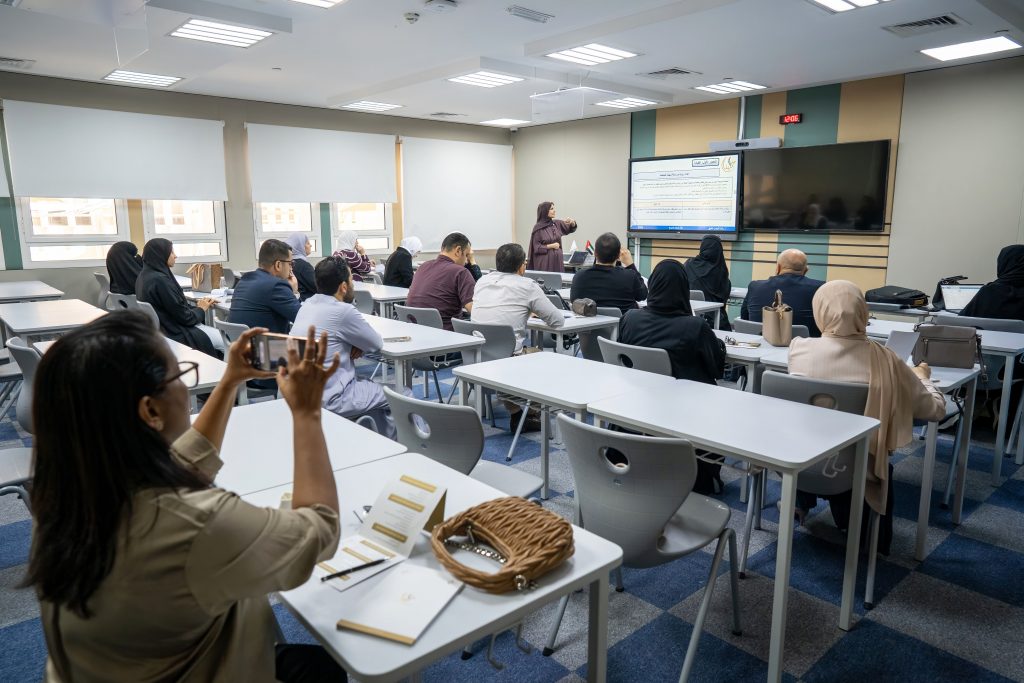
The General Secretariat of the Khalifa Award for Education, one of the institutions of the Erth Zayed Philanthropies, continued implementing the introductory program for the Applied Excellence Workshops in its 19th session. The activities, held at the Mohamed bin Zayed University for Humanities in Abu Dhabi on Sunday, September 14th, included introducing the fields presented in the current session, which are 10 fields divided into 17 categories covering various aspects of education. Among these categories is the distinguished Emirati family that provided support in creating a stimulating environment for their children to excel academically.
Humaid Al Houti, Secretary-General of the Khalifa Award for Education, emphasized the long-standing and crucial cooperation between the Award and the Mohamed bin Zayed University for Humanities. Al Houti expressed his gratitude for the University’s hosting of the Applied Excellence Workshops Program, which is designed to acquaint the educational community with the proposed fields and the specific criteria for nominations. Experts and academics specializing in various fields, along with their respective categories, participated in these workshops.
Al Houti stated that the workshop program included various sessions, including the General Education workshop, which fell under the “Creative Teacher” category, moderated by Dr. Naima Al Hosani and Raeda Faisal. This workshop included a definition of the concepts associated with the creative teacher at the local and regional levels, as well as the exceptional performance that the creative teacher should provide and measuring this within clear performance standards and indicators.
As for the Institutional Education Performance category workshop, Khawla Al Suwaidi and Al Reem Al Menhali discussed this category, highlighting that it is open on the UAE level and shared that it encompasses public education schools, technical institutes, private schools, and similar institutions that operate as integrated educational entities. Schools that have demonstrated outstanding academic excellence in their field are eligible to apply under this category.
The Secretary-General of the Khalifa Award for Education highlighted that the program also featured a workshop on People of Determination, during which Baria Suleiman, Khaled Abu Alwan, and Dr. Khaled Al Barakat spoke. The moderators provided a comprehensive overview of the People of Determination, categorizing them and highlighting the distinguished care provided by individuals, institutions, and specialized centers to empower this group and integrate them into society.
Dr. Hussein Al Othman and Dr. Naima Qasim presented the workshop related to the Education and Community Service Field, where they addressed this field’s central role and connection to the “Education is Everyone’s Responsibility” initiative. This field honors institutions and distinguished Emirati families, who are recognized for their outstanding contributions to supporting their children’s journey towards excellence.
The program also included a workshop on Innovation in the Arabic Language Teaching Field, presented by Dr. Majdi Ben Souf and Mahra Al Nuaimi. At the same time, the Higher Education Field workshop featured speakers from Dr. Labidi Bouabdallah and Dr. Fathallah Ali Rayhan, who explained the candidacy conditions for university professors, while emphasizing the integration of sustainability and the utilization of artificial intelligence and advanced technology in the educational process.
Dr. Hassan Tairab presented a workshop on the field of Educational Research, discussing it as a fundamental pillar in improving academic performance. Dr. Ghanem Al Bastami and Musab Beiruti presented a workshop on Educational Authorship for Children, emphasizing the significance of enriching creative educational works for children and promoting an academic culture that strengthens their protection and guarantees their rights.
Lastly, in the field of Innovative Educational Projects and Programs, Dr. Ibrahim Al Hanai and student Ahmed Ghandi discussed the implementation of innovative ideas in the education sector by individuals, work teams, or educational institutions, and the extent to which those ideas positively influence academia.