
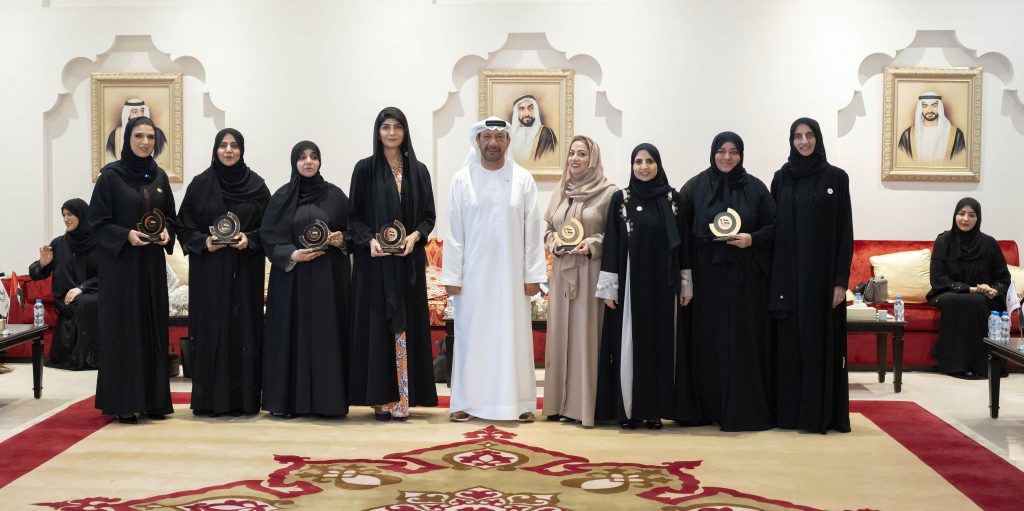
During the session “Emirati Women: A True National Legacy.”
“Khalifa Award”: The contributions of Emirati women are prominent in national development
Amal Al-Afeefi: Emirati Women deserve a unique day that commemorates their contributions and excellence
Bushra Al-Mulla: Emirati women occupy 40 percent of the workforce in education
Maryam Al-Badwawi: Emirati women have a prominent role in parliamentary life
Omniyat Al-Hajeri: A firm commitment to providing distinguished health care for Emirati women
Widad Al-Shehhi: Emirati women are a role model for national values and principles
Aisha Al-Saadi: Strengthening the role of women in society is the essence of “Al-Mubarakah”
Abu Dhabi: Tuesday, August 27, 2024
The General Secretariat of the Khalifa Award for Education highlighted Emirati Women’s Day, which falls on the twenty-eighth of August every year, as a celebration of the national achievements and gains evident throughout the UAE’s stunning journey. The Award highlighted the exceptional support granted by the late founding leader Sheikh Zayed bin Sultan Al Nahyan, who believed in the role of women and their vital role as generation nurturers and contributors to the union’s efficacy.
This came during the discussion session organized by the Khalifa Award for Education in collaboration Citizens and The Presidential Court’s Community Affairs Office – Majalis Abu Dhabi taking place at Majlis Mohamed Khalaf, under the title “Emirati Women: A True National Legacy, “in the presence of Amal Al-Afeefi, the Award’s Secretary-General and Mohammed Salem Al Dhaheri, Member of the Board of Trustees of the Khalifa Award for Education. The session was attended by Her Excellency Dr. Bushra Al Mulla, Director General of the Abu Dhabi Social Support Authority, Dr. Maryam Al Badwawi, Member of the Federal National Council, Dr. Omniyat Al Hajeri, Executive Director of the Community Health Sector at the Abu Dhabi Public Health Center, Aisha Al Saadi, Acting Director-General of the Mubarakah Foundation, and Wedad Al Shehhi, Director of the School Planning and Development Department at the Ministry of Education. Amira Mohammed of the Abu Dhabi Media Network moderated the session, which began with Amal Al-Afeefi emphasizing how Emirati women have served as a prominent model in national development at various local, regional, and international levels, as well as the lengths that the founding leader, Sheikh Zayed bin Sultan Al Nahyan, went to foster a stimulating environment that enabled community participation in various fields, thereby enhancing national development in the country.
This approach is being enhanced daily, and its position is consolidated under His Highness’ patronage, Sheikh Mohammed bin Zayed Al Nahyan, President of the UAE, and the support of His Highness Sheikh Mohammed bin Rashid Al Maktoum, Vice President and Prime Minister of the UAE and Ruler of Dubai, and His Highness Sheikh Mansour bin Zayed Al Nahyan, Vice President, Deputy Prime Minister and Chairman of the Presidential Court, and their brothers, Their Highnesses, the members of the Supreme Council of the Union, Rulers of the Emirates.
Al-Afeefi pointed out that the choice of Her Highness Sheikha Fatima bint Mubarak, Chairwoman of the General Women’s Union, President of the Supreme Council for Motherhood and Childhood, and Supreme Chairwoman of the Family Development Foundation and “Mother of the Nation” of August 28 as Emirati Women’s Day embodies the status of women and their leadership in society, and highlights their efforts and mission in building the family, achieving social cohesion, and supporting the renaissance of the national economy in various executive and leadership fields that women are proud of today as a prominent contributor to the revival, progress, and prosperity of the nation.
Al-Afeefi explained that Emirati women are the cornerstones of education. They marveled at their allocated roles as teachers, school leaders, mothers, and other roles in which women’s message is integrated to present a national model to be emulated in developing and building a bright tomorrow.
Family Stability
From her side, Dr. Bushra Al Mulla pointed out that recognizing Emirati Women’s Day indicates the interest, care, and appreciation for women and their role in all aspects of Emirati society’s life. The late Sheikh Zayed bin Sultan Al Nahyan had laid the fundamentals for empowering Emirati women, and Her Highness Sheikha Fatima bint Mubarak, “Mother of the Nation,” has provided Emirati women the proper care and keen attention, which enriched their role in their society.
Some statistics were shared, as Dr. Al Mulla specified, “Emirati women occupy more than 40% of the total employees in the education sector, about 35% in the health sector, and about 20% in the community service sector. A whopping 23,000 businesswomen manage projects worth more than 50 billion dirhams and occupy 15% of the positions on the boards of directors of the chambers of commerce and industry in the country.
Discussion showcased how Emirati women have demonstrated greatness and leadership in all fields, professionally making their families and country proud, as they are an ever-giving flame constantly enlightening with innovative ideas. Furthermore, Al Mulla emphasized women’s important role in preserving our national identity and cultural heritage and instilling it in our children, which is reflected in the cohesion of our society by working with the UAE’s authentic values and principles, which are the goal and means of family and social stability.
Dr. Al Mulla stated: “At the Abu Dhabi Social Support Authority, we are keen to provide the necessary support to female employees to achieve a balance between family and work by providing flexible work options and adopting national initiatives and programs that enhance women’s empowerment and support their family and societal role. There are 113 female employees at the authority, representing 64% of the total employees, including six employees holding administrative positions and six distinguished social specialists.
As part of our efforts at the Abu Dhabi Social Support Authority aimed at providing an integrated social safety net for low-income families across the Emirate of Abu Dhabi, the Authority has contributed to giving various and diverse empowerment programs in cooperation with its partners for more than 1,558 women within the families benefiting from the Authority’s early programs. Dr. Al Mulla emphasized, “Such programs granted employment opportunities to 764 women and trained 667 Emirati women. Regarding the continuing education programs, they have supported 225 Emirati women.” She elaborated, “The Emirati Family Growth Support Program, recently launched by the Department of Community Development – Abu Dhabi, includes a group of significant initiatives, including the Easy Marriage Advance Initiative and the Maternity Leave Support Initiative for Female Workers in the Private Sector. The Abu Dhabi Social Support Authority supervises these initiatives and provides related services. These services aim to enable employees about to get married to start a stable married life, facilitate the establishment of the family, and ensure that the mother gets enough rest and time to care for her newborn. These ongoing initiatives are aimed at establishing a cohesive, stable, and independent family, thereby establishing a more prosperous and giving society.
Parliamentary Participation
Dr. Mariam Al Badwawi addressed indispensable Emirati women accomplishes by sharing how their contribution to enhancing parliamentary participation in the Federal National Council and instilling an awareness of its importance in young people from an early age, which improves the agenda of women’s empowerment and conveys the wise leadership’s directives in developing their capabilities and skills to participate in national development. According to Dr. Al Badwawi, the political empowerment initiative has resulted in women making up 50% of the members of the Federal National Council. Such statistics have provided them with significant opportunities to participate in parliament. Women took over the presidency of the Federal National Council for the first time in 2015. The percentage of women’s representation in the council has increased to 50% since then, reflecting the state’s commitment to supporting women in decision-making positions and empowering them to play a leading role in society, which is reflected positively in the Emirati family.
Healthcare
Dr. Omniyat Al Hajeri commented on the country’s endeavors to establish a state-of-the-art healthcare system for mothers and children, stating that the Abu Dhabi Public Health Center is committed to enhancing health and safety measures for mothers and children to enjoy throughout the emirate. This is achieved by ensuring the provision of services that are characterized by advanced quality and that meet the needs of mothers during pregnancy and childbirth, as well as by focusing on early childhood due to its role and impact on the development of the child’s personality and the characteristics of their future.
Dr. Al Hajeri further declared, “The Abu Dhabi Public Health Center’s initiatives and programs include various educational and awareness programs that address essential topics such as proper nutrition, maternal and child health, immunizations, prevention of common diseases, promoting breastfeeding, and positive parenting techniques to empower mothers and help them create a healthy and safe environment for their children. The center also provides mothers and children with comprehensive psychological and social support to ensure their well-being.
The Abu Dhabi Public Health Center is constantly keen to evaluate and improve its programs and services to meet the evolving needs of mothers and children and ensure their health care and well-being via its partnerships and close cooperation with various concerned parties and stakeholders in the community, stressed Dr. Al Hajeri.
Educational Excellency
Regarding the role of Emirati women in promoting education, Wedad Al Shehhi stated that Emirati women’s role in developing society is synonymous with refinement and progress, as they have always been men’s supporters in building culture, constructing its framework, and striving to advance it.
She continued: “Observing the progress of Emirati women’s journey evokes a sense of pride and admiration, as they consistently attain remarkable accomplishments and embody a commendable role model for ambitious women. Equipped with strong values and principles, they demonstrate their ability to excel globally in various domains through their knowledge, intellect, and creativity.”
Al Shehhi demonstrates sensible leadership faith in women’s pioneering roles by focusing on empowering women to overcome any problems they face with steady steps, creating an ambitious strategy for the future.
Al Shehhi stated that allocating August 28th to commemorate Women’s Day and their achievements best indicates support for Emirati women’s journey, which will continue with future generations to achieve continuity of giving, devotion, and achievement in all areas, domains, and industries. She adds, “Today, we are all proud of the world for what they have accomplished in terms of a respectable position recognized at the national and global levels.”
Volunteer Work
Aisha Al Saadi, representing the Al Mubarakah Foundation, stated that the Foundation believes women are essential to building families and social cohesion, and generations are proud of their national identity and the civilized gains and achievements they are witnessing. She said, “The Mubarakah Foundation’s message reflects our competent leadership’s recommendations to advance women in national labor, community service, and family improvement. The Foundation and key partners undertake these programs as part of an integrated system to raise community understanding of women’s roles and positions.”
The latter role represents an integrated system of good energy that Emirati women bring to the community. Within this framework, women play a substantial part in promoting the culture of volunteering and humanitarian action locally and globally. Such presence is increasing daily. Al-Saadi declared, “We mention, as an example, a number of these initiatives and practical workshops implemented by the Foundation, including the Maghaweer Program, in which we provide awareness, guidance, and practical workshops in collaboration with qualified specialists and consultants in the health, cultural, social, and skill fields to support parents with the requirements to support adolescents and enhance cultural, social, and national awareness among adolescents.”
Concluding the session, Amal Al-Afeefi commemorated the speakers and presented each of them with an award shield in appreciation of their participation.