
Abu Dhabi – Friday, 28 August 2026
The General Secretariat of the Khalifa Award for Education, an institution of Erth Zayed Philanthropies, affirmed that Emirati women have set a distinctive national example in the UAE’s development, progress and prosperity through their prominent contributions across all areas of national development. Foremost among these is their role in building cohesive and accomplished Emirati families that take pride in their national identity, cultural heritage and the country’s development achievements.
The General Secretariat noted that Emirati women have become a key pillar of the UAE’s strong performance across international competitiveness indicators in a wide range of fields, particularly social development, education and healthcare. Their achievements across these and other sectors reflect the care and support extended by the UAE’s wise leadership to women, as well as its commitment to their empowerment and to strengthening their role in society.
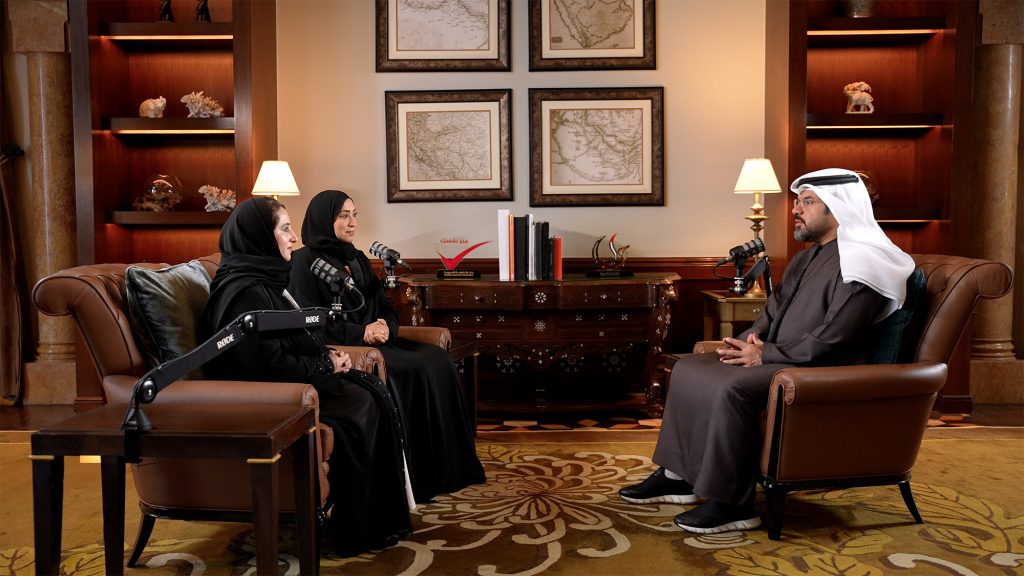
The remarks came during a virtual panel discussion organised by the General Secretariat of the Award as part of the UAE’s celebrations of Emirati Women’s Day, under the title ‘Emirati Women: A Leading Role in Education’. The session was attended by Humaid Al Houti, Secretary-General of the Khalifa Award for Education. Speakers included Dr. Najla Al Naqbi, Vice Chancellor for Academic Affairs at Mohamed Bin Zayed University for Humanities, and Dr. May Al Taee, Vice Chancellor of Emirates College for Advanced Education. The session was moderated by Dr. Khalid Al Abri, a member of the Khalifa Award for Education Committee.
Opening the session, Al Houti highlighted the leading role played by Emirati women across the country’s various fields of work and national productivity, particularly in education, which has been one of the vital sectors in which Emirati women have recorded significant national achievements since the establishment of the Union.
For her part, Dr. Najla Al Naqbi spoke about the excellence and leadership that have characterised the journey of Emirati women across all fields, particularly their role in building the Emirati family and strengthening social cohesion. She said the UAE takes pride in the achievements of women across all sectors, especially education, which is one of the key pillars of national development and a field in which Emirati women make a significant contribution as teachers, administrators and educational leaders across different educational institutions.
She added that, as the UAE marks Emirati Women’s Day, the social messages that deserve particular emphasis include highlighting the wise leadership’s support for Emirati women, advancing gender balance, and strengthening equal opportunities in education, employment and community service — all areas in which Emirati women have demonstrated their capability and excellence.
Dr. Al Naqbi said that no discussion of the journey of Emirati women would be complete without acknowledging with gratitude the efforts of H.H. Sheikha Fatima bint Mubarak, ‘Mother of the Nation’, Chairwoman of the General Women’s Union, President of the Supreme Council for Motherhood and Childhood, and Supreme Chairwoman of the Family Development Foundation.
She noted that Her Highness has been a pioneering force and a key driver of the advancement of women, from the launch of the national literacy campaign in 1975 to her support today for programmes in space and artificial intelligence. Between these milestones, Her Highness has continuously supported the empowerment of girls, including through the H.H. Sheikha Fatima bint Mubarak Award for Academic Excellence and the establishment of the Family Development Foundation, which provides services and programmes that support marital compatibility and work-life balance.
Dr. Al Naqbi said that these combined efforts laid strong foundations for women’s academic success and family stability, later reinforced by the National Strategy for Empowerment of Emirati Women in the UAE 2023–2031, which consolidated women’s leadership role while preserving the central importance of the family.
She stressed that the UAE has launched pioneering national initiatives to advance women’s education since the beginning of the Union. Today, that focus continues in the age of artificial intelligence and digital awareness, including the need for broader national programmes to educate parents about artificial intelligence, digital safety and digital parenting so that families become informed partners in the digital transformation of education rather than passive observers.
She said today’s generation interacts daily with generative artificial intelligence, search engines, digital platforms, social networks and open content. This raises a question that did not carry the same urgency only a few years ago: how can the Emirati family raise a generation that uses technology without losing its identity, values or ability to think independently?
Dr. Al Naqbi added that the role of Emirati women is evolving once again. In the next stage, mothers will need not only to follow their children’s academic performance, but also to develop an appropriate level of digital literacy, awareness of artificial intelligence and digital safety, and critical-thinking skills. Artificial intelligence may provide a student with an answer within seconds, she said, but it is the family and the school that teach the student to ask: Is this information correct? What is its source? Am I allowed to use it? Did I produce this work myself? And does my use of technology align with my values and ethical responsibilities?
In this context, she said, Emirati women have a central role in building what may be described as a ‘smart and aware family’, rather than merely a family that uses technology.
Dr. May Al Taee, Vice Chancellor of Emirates College for Advanced Education, said: ‘Since the founding of the Union by the late Sheikh Zayed bin Sultan Al Nahyan, the Founding Father, Emirati women have benefited from the development of education and have become one of the vital strategic pillars of the education journey and human development. As teachers, educators, academics, leaders and mothers, they have contributed to preparing generations equipped with knowledge, values and national identity.’
She added: ‘Today, thanks to the vision of our wise leadership and the attention and support of H.H. Sheikha Fatima bint Mubarak, Mother of the Nation, Chairwoman of the General Women’s Union, President of the Supreme Council for Motherhood and Childhood, and Supreme Chairwoman of the Family Development Foundation, Emirati women continue to receive strong support and empowerment. Their impact and role are expanding as active partners in shaping the future of education — from schools and families to research, innovation and educational leadership.’
Dr. Al Taee continued: ‘Anticipating the future of education is inseparable from the future of the family. Schools, families and educators form an integrated ecosystem, and Emirati women stand at the heart of this ecosystem, drawing on their knowledge, experience and ability to combine values, innovation and future thinking.’
‘At Emirates College for Advanced Education, we believe that investing in educators and empowering national talent is a direct investment in future generations. From my experience in the education sector, I believe what Emirati women have achieved today is not an end point, but a foundation from which to create deeper impact — continuing to lead positive change, strengthen the role and cohesion of the family, contribute to building a more cohesive society, and shape the future of education.’
Dr. Al Taee said the UAE has established an integrated ecosystem of legislation, laws, strategies and programmes that strengthens Emirati women’s role and national mission. She said this support began under the Founding Father, the late Sheikh Zayed bin Sultan Al Nahyan, who believed that women represent half of society and that their effective participation in society’s progress and prosperity is a national priority.
She added that this approach continues under His Highness Sheikh Mohamed bin Zayed Al Nahyan, President of the UAE, with Emirati women contributing every day to the country’s national achievements. She also expressed gratitude for the leading role of H.H. Sheikha Fatima bint Mubarak, Chairwoman of the General Women’s Union, President of the Supreme Council for Motherhood and Childhood, Supreme Chairwoman of the Family Development Foundation and ‘Mother of the Nation’, and for Her Highness’s prominent efforts in supporting the wise leadership’s directives on women’s empowerment and strengthening their national role.
Concluding the session, Dr. Khalid Al Abri said that Emirati women’s contribution to national development is one of the fundamental pillars upon which the UAE’s journey has been built. With pride in their mission and roles, Emirati women are mothers who raise generations and shape the future, while contributing positively across all areas of national development.