
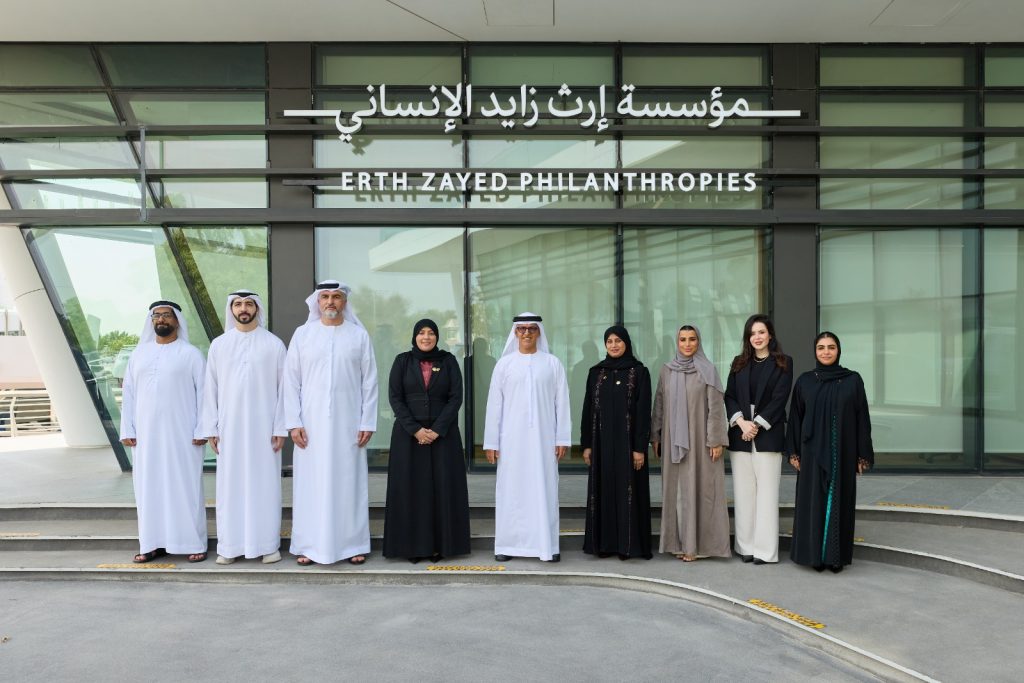
Abu Dhabi, Wednesday, 21 October 2026:
H.E. Dr. Mugheer Khamis Al Khaili, Secretary-General of Erth Zayed Philanthropies, affirmed that education was a fundamental pillar of the vision of the UAE’s Founding Father, the late Sheikh Zayed bin Sultan Al Nahyan, who believed that investing in education was an investment in developing people and securing the future of generations to come. He noted that this vision laid the foundations for the UAE’s education system, which continues to advance and excel under the guidance and support of His Highness Sheikh Mohamed bin Zayed Al Nahyan, President of the UAE, further strengthening the country’s position and leadership in education at regional and international levels.
His remarks came as he received a delegation from the Qatar Education Excellence Award at the headquarters of Erth Zayed Philanthropies in Abu Dhabi. The delegation was led by Ms. Maryam Abdullah Al-Mohannadi, Chief Executive Officer of the Award, and included Ms. Fatima Ahmed Al Rashid, Chairperson of the Award’s Development Committee. Humaid Al Houti, Secretary-General of the Khalifa Award for Education, also attended the meeting, during which both sides discussed opportunities to strengthen cooperation, exchange expertise and advance initiatives supporting educational excellence.
Welcoming the Qatari delegation, H.E. Dr. Al Khaili commended the longstanding fraternal ties between the UAE and Qatar across various fields. He also outlined the mission of Erth Zayed Philanthropies in carrying forward the philanthropic legacy of the late Sheikh Zayed bin Sultan Al Nahyan. Through its network of affiliated philanthropic organizations, Erth Zayed Philanthropies brings together diverse expertise and capabilities across key areas of human development, including education, to strengthen local capacities, expand opportunities and create lasting
positive impact for communities across generations. He noted that the Khalifa Award for Education is one of the key institutions within the Erth Zayed Philanthropies network. Established in 2007 to promote excellence in higher and pre-university education, the Award has made significant contributions at local, regional and international levels over nearly two decades.
During the meeting, Al Houti presented the ten fields and 18 categories of the Khalifa Award for Education’s twentieth cycle, which cover various aspects of education. He explained that its nomination, evaluation and winner-selection criteria are based on key considerations, foremost among them the positive humanitarian impact of submitted work, commitment to sustainability and community service, and the use of advanced technologies and artificial intelligence.
He added that the Award has recognized 651 winners from 52 countries since its establishment. More than 2.5 million people worldwide have engaged with the Award through its platforms, and it has received more than 12,000 nominations from eligible applicants. Al Houti also highlighted prominent Award categories, including the Educational Personality category, which honours individuals whose contributions to education and society have made a significant positive humanitarian impact. He also discussed the Distinguished Emirati Family category, which recognizes families that provide an environment conducive to their children’s academic excellence and instill national identity and positive citizenship.
For the first time in its current cycle, the Award has introduced a dedicated artificial intelligence category targeting student teams and emerging researchers undertaking research projects that use AI tools to develop education systems.
Al Houti also highlighted the Khalifa International Award for Early Learning, introduced by the Khalifa Award for Education as the first award of its kind worldwide to showcase leading scientific and practical approaches to early childhood care and development. He noted that it has attracted considerable interest from international institutions and renowned research centers specializing in early childhood research and studies.
For her part, Ms. Maryam Abdullah Al-Mohannadi, Chief Executive Officer of the Qatar Education Excellence Award and head of the Qatari delegation, expressed her appreciation for the prominent standing of the Khalifa Award for Education and its role in supporting educational excellence locally, regionally and internationally. She emphasized the importance of the visit in strengthening cooperation and facilitating the exchange of expertise and institutional best practices between the two awards.
Al-Mohannadi explained that, since its establishment in 2006, the Qatar Education Excellence Award has consolidated its position over two decades as a national award dedicated to recognizing academic excellence, fostering a culture of excellence, creativity and innovation, and showcasing outstanding individuals and their academic and educational achievements.
She added that the Award is undergoing a comprehensive and continuous process of institutional development encompassing its organizational, operational and technological systems, working mechanisms and criteria. This also includes exploring opportunities to develop its institutional framework to enhance efficiency, improve the quality of its outcomes and sustain its impact. The aim is to expand its role beyond recognizing outstanding achievers to drawing on their experiences and accomplishments, in line with Qatar National Vision 2030.
Al-Mohannadi stressed the importance of closer cooperation among educational and scientific awards and the exchange of successful experiences to strengthen institutional performance, promote a culture of excellence and maximize their contribution to the development of education systems.